

Another World is Possible
The gap between our moral aspirations for the world and global reality has never been greater

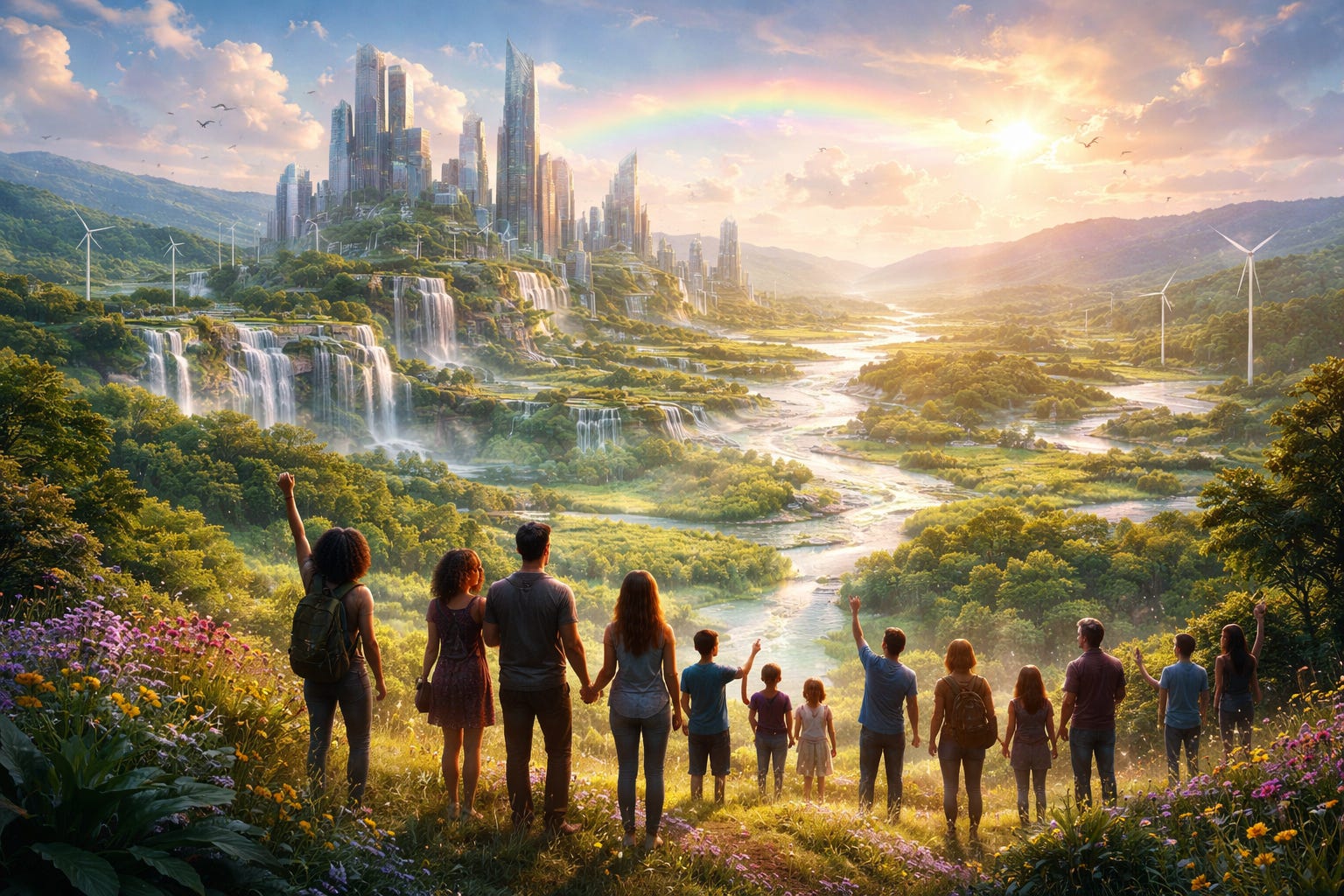
If, like me, you were born in the decades following 1945, then you’re part of the most fortunate generation in history.
One of the consequences of growing up at a time when technological advance was driving unprecedented economic expansion, and when governments recognised the importance of keeping as many people as possible inside the tent of economic security, was to increase the moral aspirations of millions of people.
A Rising Tide Lifts all Boats
We felt the benefits of a world in which, if we made the most of our education and were prepared to work reasonably hard, a rewarding and fulfilling life would follow. As John F. Kennedy said in 1963, ‘a rising tide lifts all boats’. We were lucky to have been on board at a time when as much attention was paid to the distribution of the benefits of a growing economy, as to economic growth itself. Given our good fortune, why wouldn’t we want others to enjoy the same experience?
For many of us, a loving and secure experience of childhood meant we were equipped to make the most of the opportunities that subsequently came our way, thanks to a comparatively stable political and economic environment. It’s even possible that this positive experience affected our psychological development, instilling an expectation of continuing social progress, and the hope that over time yet more people might have a better experience of life.
There is no natural or economic law that means a period of such progress is necessarily time-limited. History may suggest that we make progress in fits and starts, each step forward invariably followed by two steps back. But this is not inevitable. After two world wars, the great depression and the Holocaust, many democracies chose enlightened politicians to lead us down a different, more inclusive, path. That path still exists, but getting back on to it from where we are now will require a Herculean effort.
Some cynics already view the post-1945 period as a historical blip. Perhaps such progress is only possible after a period of successive moral disasters, the effects of which touch the lives of almost everyone? If that’s true, then surely we’ll be due another moral reset before long. But having survived the first half of the 20th century just about intact, do we really need to go through the whole thing again? Is there really no learning from history?
I think there can be, but we have clearly failed to learn how to prevent the kind of men —and yes, it is always men, as Christina Patterson reminds us in her excellent recent post — who drag us into war and allow the economy to be hijacked by minority interests, from getting into power in the first place. Why does so much economic and political power end up in the hands of a small number of damaged men who seem intent on ruining things for the rest of us? And why can’t democracy prevent this?
As regular readers will know, I think the key to this is to bring the economy (back?) under democratic control. And this means reconfiguring it to serve the interests of the majority. It goes without saying that this demands a quite different kind of politics to that we have today.
Why does the Overton Window only open one way?
The Overton Window is one of the most interesting concepts in political science. It argues that there is a limited range of ideas or policy positions that are acceptable at a given time, assuming those espousing them wish to be taken seriously, and be elected to or remain in public office. If politics is the art of the possible, then the Overton Window tells us what, realistically, is possible.
But perhaps because its originator was a staunch libertarian, the Overton Window only seems to open one way, at least in recent times. Today, policy positions that are overtly racist, anti-Semitic, misogynistic or homophobic, and which would not have dared be uttered by ambitious politicians until very recently, are common currency. In the process, ordinary people have been given licence to voice their own extreme views without fear of being ostracised. The Window has been flung wide open by Donald Trump and his vile henchmen in the United States, and is currently sitting invitingly ajar for Nigel Farage here in the UK.
There’s a simple explanation for this: it’s much easier to persuade people to vote according to their emotions and their base instincts, than it is to get them to engage in rational reflection, or take a few minutes to consider what is happening in the world in moral terms. My next piece for The Bear examines the connection between morals and the political choices people make. Look out for it on Saturday morning.
How do we push back?
After his tragically early death in a flying accident, Joseph Overton’s work was continued by his colleague Joseph Lehman, who coined the term Overton Window. Lehman was at pains to point out the political neutrality of the idea. Clearly there is nothing intrinsic to the concept that restricts its use to one particular end of the left-right political spectrum.
I would go further than Lehman and argue that when we’re talking about how best to get new ideas into the mainstream, it would be helpful not to be bound by the old left-right dichotomy at all. More of that in a future piece entitled Beyond Left and Right, which I’ve been working on for ages and which I’m determined will eventually see the light of day.
Lehman also thought that politicians do not attempt to move the window: rather their approach is simply to identify where it is and align themselves with it. At a time when the world is crying out for inspired moral leadership, this may be depressing, but it’s largely true of today’s politicians, notwithstanding Trump (see above re: appealing to base instincts).
I’ve written previously of my belief that getting back on the path of progress towards a more just, inclusive and sustainable world will depend as much on the emergence of a leader (or leaders) with the ability to tell relatable stories about how we got here, and how we might tackle the challenges we all face, in a way that appeals to voters of different political persuasions: another world is possible, and this is how we get there.
Of course, the efforts of activists, campaigners, writers and those already involved in politics who share a belief in the possibility of a better world, remain important. But from where we are today, it’s difficult to see how we can turn things around without inspired moral leadership and vision. And ideally, such leadership would emerge in several countries at once. The challenges we face are global in nature: climate, conflict, inequality, extremism; and they require global solutions.
The Centre Must Hold
Clearly, while we wait for such leaders to emerge, it is better to be governed from the centre by politicians who will at least try to hold back the tide of exclusivist, populist authoritarianism that currently threatens our democracies. But it’s difficult to see how, given the way the economy has been hijacked by minority interests, the kind of centrist economic policies employed for much of the period since 1945, could deliver a less unequal, more inclusive economy.
It may be possible to resurrect a model through which the needs of those for whom the economy doesn’t cater are provided for by redistribution via taxes on the earnings of others. But it might be an easier sell to persuade electorates to strike out in an entirely new direction, instead of returning to a time when politicians said all the right things about fairness and inclusion, but allowed free-market driven economic changes to drag us in the opposite direction.
The social, cultural and technological progress of recent decades has been remarkable. The focus now should be on transforming the economy so that everyone can begin to enjoy the benefits of those advances.
Six Wasted Decades
I’d completed a first draft of this piece when Mustafa Santiago Ali reminded me of these words, written by Dr. Martin Luther King in his May 1967 report to the staff of the Southern Christian Leadership Conference:
‘We must recognise that we can’t solve our problem now until there is a radical redistribution of economic and political power…. This means a revolution of values and other things. We must see now that the evils of racism, economic exploitation and militarism are all tied together… you can’t really get rid of one without getting rid of the others…’
Dr. King recognised what it would take to create a world that values the lives of all people equally, and provides opportunities for everyone to make their own way in life. We’ve spent most of the last six decades failing to take heed of his words.
Most people don't want war, they don’t want higher fuel prices, and they’re sick of having to pay ever more for their weekly shop. Younger people resent the fact that they don’t earn enough to buy their own homes when they’ve worked as hard as their parents did. And their parents don’t want to see the value of their hard-earned pensions eroded away by constant inflation.
These things are only inevitable as long as we allow warmongering maniacs into positions of power, and a tiny self-interested elite to control the economy. This doesn’t mean turning the clock back to 1945 and resurrecting policies that were right for the special conditions of that time. But it is perfectly possible to arrange the economy differently. It just requires enough of us to recognise that possibility and find a way to use the power of democracy to make it happen.
Brilliantly executed. I too share the heart I discern in this writing, and I see how my own piece aligns with all that you’ve expressed here. I had just posted my reflection and was about to close out for the day when this article appeared in my timeline. I had to read it, and I am so grateful that I did. Knowing there is a collective consciousness aligning with what I am seeing, sensing, and living through my practice encourages me tremendously to continue on this path. I’m truly glad I paused before exiting the platform.
Fascinating piece, Mark and many thanks for mentioning mine. I share your vision, but have little clue how we might get there. But we absolutely have to keep hope alive.