Holiday Reading
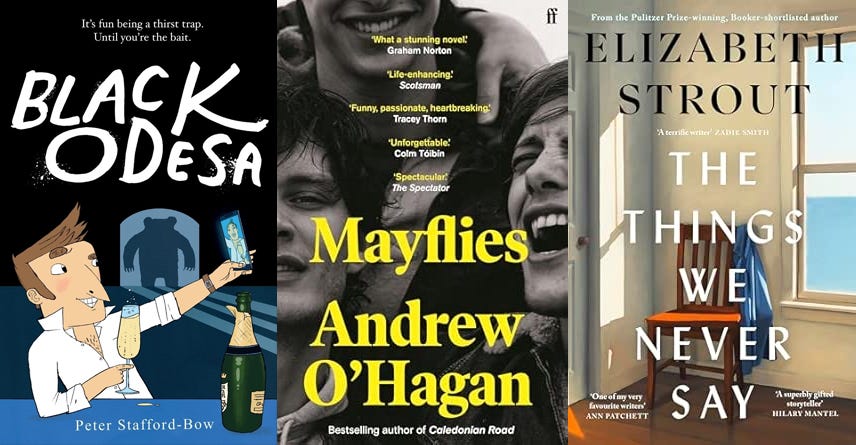
Three sublime but quite different novels recommended by Substack friends

I’m just back from a week in Puglia where the weather was more conducive to reading than to visiting the region’s many wonderful hilltop towns - though we did plenty of that too.
Anticipating the semi-tropical, London-like weather, and knowing we had a pool to sit beside, I took three novels recommended by friends here on Substack. Happily, they were all fabulous. One made me laugh out loud so frequently my wife had to retreat behind her airpods. The concluding chapters of the other two, however, had me reading through floods of tears.
So here goes, in the order I read them.
Black Odesa by Peter Stafford-Bow - you can buy it here.
If, like me, you’d read all of Ian Fleming, Franz Kafka and Brett Easton Ellis by your mid-twenties, and gone on to enjoy Edward St Aubyn’s Patrick Melrose novels in your forties, then I guarantee you’ll enjoy Black Odesa.
The only mystery to me is why I didn’t discover the Felix Hart novels before the author offered to send me a review copy of his latest. I’ve been an interested if peripheral observer of the wine trade since undertaking the WSET Diploma back in 2018, and while I’ve never worked in the trade, drinking wine and reading novels are two of my favourite pastimes, and this novel is located firmly at the centre of the UK wine trade.
I don’t think I’ve ever laughed so much at a novel in my life. My favourite comic novelist, Magnus Mills, runs Stafford-Bow a close second, but Mills tends to provoke a wry smile every third sentence, while Stafford-Bow had me in stitches virtually every paragraph. What these two writers have in common, however, is their remarkable gift for observation, and the ability to find a laugh, or at least a smile, in the most mundane of situations.
Stafford-Bow also has something in common with the great Elena Ferrante, as both write under pseudonyms. I have no desire to learn the real identity of either, but, just as Ferrante’s Neopolitan novels could only have been written by someone who’d grown up in one of Naples’ impoverished riones in the 1950s and 60s, so Stafford-Bow can only have spent his career in the wine trade. Black Odesa seeps the stuff from every pour, and his characterisations have foundations of such authenticity, I wish I knew more people in the business so I could hazard a few guesses.
The novel is exceptionally well-written, giving a just-beyond-believable account of the trials and tribulations of a supermarket wine buyer who falls on straitened times, gets himself into a world of trouble as a result, before eventually coming up smelling more or less of rosés by the end. The brilliantly disguised denouement was so explosive I almost fell off my sunbed.
But it’s more than a meticulously plotted comic novel, it’s more than a thriller, and it’s more than a insider’s quasi-fictional view of the wine trade. It skewers the narcissism of contemporary culture brilliantly, especially the world of influencers, or vinfluencers. The scene in which most of the plates sent out by the kitchen at a top London restaurant are returned untouched as they were only ordered for photographic purposes is all too believable.
The author effortlessly pre-empts accusations of sexism or of being deliberately un-pc. When you’re writing about relations between men and women, all you need to do is make the women cleverer than the men (not difficult) and to write honestly about the knotty problem of male desire. And Stafford-Bow adeptly avoids any risk of nomination for the Bad Sex in Fiction Award.
But does Black Odesa have an audience beyond people who know something about wine? I think it does, because it’s a bloody good story, it stands up perfectly well on its own — you don’t need to have read the previous four books in the series — and it’s funny as hell. You may not get all the wine references, but so what.
A small part of me fears that Stafford-Bow is so clever that he wrote the book in the hope that someone might give it a review smattered with earnest literary comparisons just to prove a point. But I can cope with that. My only real problem, having read the fifth book in the series first, is that I now need to read the other four. I’ll just have to book another holiday.
Mayflies by Andrew O'Hagan - you can buy it here.
I took this book with me after Mark Diacono wrote about it a couple of weeks ago. Mark and I have become friends on Substack, but we go back much further as we went to the same school. Mark was a couple of years below me, in the same year as my brother. I was delighted when he remembered us both after I commented on one of his posts a couple of years ago.
It soon became clear that we still share a passion for music, and he recommended Mayflies because it focusses on the friendship of two men who grew up in Ayrshire, but made the trip to Manchester for a much celebrated gig at G-Mex in 1986, the tenth and final event in the grandly titled Festival of the Tenth Summer. For younger readers, the reference is to the tenth anniversary of punk. And the reason the novel resonated so strongly with Mark was because, as he wrote in his piece,
‘I was at that gig, as was my oldest friend. And as long as I live, I will never spend a better £13.’
The list of bands that Mark, and I presume Andrew O’Hagan, saw on that balmy July day is frankly mind-blowing. That the gig was compered by the estimable Paul Morley is no surprise; but picking Bill Grundy as co-host was a brilliant bit of casting by the festival’s legendary organiser, Tony Wilson. Younger readers will have to google Bill Grundy to find out why.
As Mark says, it’s a ‘book about friendship, youth, music, middle age and death,’ and it dissects each of these quite beautifully. O’Hagan writes poignantly about growing up in Thatcher’s Britain, where massive economic and social upheavals had serious consequences for the lives of young people, both in terms of their own prospects and the impact it had on their parents’ ability to parent.
But it’s the way he deals with death, with the knowledge of impending death, and the immensely difficult topic of assisted dying that really sets this novel apart. And without spoiling any plots, it also makes you think about the difference between friendship and marriage; another complex topic, and one too rarely discussed.
This might not be the book to read if you’ve recently suffered a bereavement, although in my experience, reading about death and dying when it’s described as beautifully as it is here can be wonderfully cathartic.
The Things We Never Say by Elizabeth Strout - you can buy it here.
Of the three, this is the one I would take to my desert island. I’m not even going to try to review it; Christina Patterson’s account is as good as a book review gets, so do check it out. As she writes,
‘No novel has captured the earthquake that has hit the United States of America in the last decade better than this.’
She’s dead right, even though it barely touches on politics. And she was right again when she wrote:
‘I felt like stopping the world and yelling: you have to read this! You have to read this because it’s telling the truth about life on this planet.’
Which is remarkable, because on the surface it’s a straightforward story about ordinary people navigating their way through the punctuated normality of daily life. And the punctuations aren’t that remarkable in the scheme of things - it’s the way Strout writes about them that makes you think about how difficult life can sometimes be; the immense resourcefulness of human beings in rising to the challenges we all face from time to time, and the fact that some problems have no resolution, however much we wish they did.
In one sense it’s a book about good and evil, but only because it spends most of its length analysing the space between those two extremes. Much of the goodness is embodied in our hero, Artie Dam, a high school history teacher who cares much more about his students than he does about himself. The gentle way he gets his charges to think about the world, their relationships with others, and the life awaiting them in adulthood is almost superhuman.
Yet Artie is a simple soul in many ways, struggling in his relationships with other adults, including his wife and son, and most of their friends. Until, following a near catastrophe, he strikes up a friendship with someone he can talk completely freely with for the first time in his life.
The story is set in the period before and after the 2024 US Presidential election, so inevitably politics creeps in. But in the way she resolves a series of conflicts which could easily spiral out of control, Strout reminds us that we all have agency, and we all have the capacity to understand what it takes to get along with our fellow human beings. We just need to talk more, and more kindly, to one another.
Ultimately, it’s a book about the power of human decency in the face of violent social and cultural changes intentionally unleashed on the lives of people who know in their bones that what’s happening to their country is profoundly wrong. Some people may interpret it differently, but I think Elizabeth Strout makes this point elegantly while avoiding antagonising anyone.
It’s imperative that we reject the notion that art and politics shouldn’t mix. In The Things We Never Say, Elizabeth Strout shows us why.
Thanks for reading. If you enjoyed this post then please to click on the ‘like’ and ‘restack’ buttons for I am told that engagement is the key to success on substack and getting one’s writing in front of more readers. Many Thanks, Mark.