

Optimism, Pessimism, and Progress
The lessons of history must not be ignored, now more than ever

Two decades have now passed since the publication of my book, The Possibility of Progress. Given how long it took me to find a publisher, not to mention the years I spent working on it, it’s fair to say I’ve been concerned with the question of whether progress is possible for the best part of thirty years now.
Any discussion about progress demands a definition of what we understand by the word. For me it means changes to the social, political, economic and cultural and institutions that govern our lives such that more people are able to have a positive experience of life.
I’m not going to get into a discussion about what constitutes a sufficiently positive experience of life, not today anyway. There is still far too much poverty, homelessness, hunger and insecurity in the world (including the rich countries) for any reasonable person to doubt that we still have a long way to go.
But it’s also important to remind ourselves of how much progress we have made. The numbers of people who now enjoy secure, fulfilled lives is evidence of remarkable historical progress. And if we’ve come this far, there’s no reason we can’t go further. The best argument for the possibility of further progress is that which we’ve already achieved.
Twenty Years Later
The world has changed a great deal over the last twenty years. I wrote the book because I was frustrated at the lack of progress. Certainly, the two most populous nations on the planet were leading the way in lifting millions out of poverty through economic development. Nonetheless, it seemed unlikely that their embrace of free market capitalism would succeed in delivering the goods to more than a decent minority of their citizens. Despite the remarkable pace of change, that has turned out to be the case.
I wasn’t motivated to write it because I feared a resurgence of support for politicians of the far right. I had read widely on the factors enabling Hitler’s rise to power, and also the means by which Stalin contrived to send so many people to their deaths. But I didn’t think we were anywhere near a return to the conditions that gave rise to those two monsters, and enabled their evil deeds. And I still don’t. The threshold at which people are prepared to give up on democracy and the rule of law, and lend their support to putative tyrants, seems to have reduced considerably over the course of the last century.
But while that threshold may have slipped, the lessons of history remain. For democracy to endure, far greater attention needs to be given to the perceptions of the ordinary people. If enough people think that nobody cares for their interests; if they are driven to the conclusion that politicians make no difference; if they perceive the economy as being arranged only to benefit minority interests; and if they they feel worse off than their parents’ generation, then we should not be surprised when they give their vote to someone offering an alternative, however unrealistic that alternative may be.
Are things really so much worse?
In his final column for The Guardian last week, Martin Kettle, whose fine words I first read in the pages of Marxism Today back in the mid 1980s, compared people’s perceptions of the world then to the perceptions of people today. His point being that for the progressive minded, there is always too much bad news and never enough good. I appreciate why he would want to sign off with a positive column, but I’m not sure you can compare the 1980s to today. He writes:
‘The Britain of the 1980s, which was the Britain in which I first started working for the Guardian, was a country whose inherited assumptions were disintegrating. It had lost an empire, but too often still thought in imperial terms; was in the midst of a necessary but sapping cold war against the Soviet Union in a wholly divided Europe; and it was a country dependent for its security on a maverick US president. They were frightening times. Yet how benign Ronald Reagan now seems.’
They were frightening times, although it was that same maverick US President, urged on by British Prime Minister, Margaret Thatcher, who succeeded in making the world a much safer place by negotiating a series of agreements to reduce the world’s stock of nuclear weapons with the Soviet leader, Mikhail Gorbachev.
It’s true: many of us felt miserable at our failure to build on the aspirations of the post-1945 order. We knew the move to low-regulation ultra-free-market capitalism would reverse many of the social gains of the post-war period. But it never felt as if civilization was under an existential threat, as it does today.
The Threat to Civilization
Five things make the 2020s much scarier than the 1980s:
climate change, not just for those people directly impacted by extreme weather events, but also the longer term economic consequences, especially food insecurity and migration
unprecedented levels of inequality, with around 3,000 billionaires now able to exert their economic power to neutralise the levelling effect of democracy
hundreds of millions still living in extreme poverty, with no possibility of free market capitalism ever delivering economic security for all
more people feeling worse off than their parents’ generation, and that the world is going backwards
the rise in support for the authoritarian far right, a movement that offers no solution to any of the above problems, and is largely a consequence of them.
This is why so many of us - though apparently not enough of us to force a change of direction - feel so anxious about what is happening today. But is there any cause for optimism?
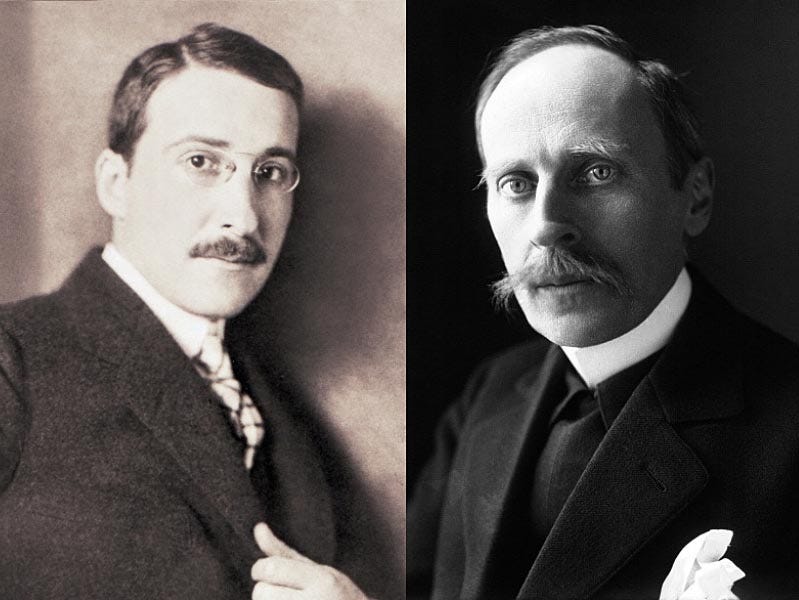
Romain Rolland and Stefan Zweig
The phrase Pessimism of the Intellect, Optimism of the Will is usually associated with the Italian Marxist thinker Antonio Gramsci. But it was originated by the French writer, Romain Rolland, who won the Nobel Prize for Literature in 1915. Gramsci, being a good egg, gave the Frenchman full attribution.
Rolland’s original formulation was as an imperative:
Il faut avoir le pessimisme de l’intelligence et l’optimisme de la volonté
Which roughly translates as ‘One must possess the pessimism of the intellect and the optimism of the will’. Hidden within these words are two important injunctions: first, not to shy away from the often grim reality of the world, and of life for so many people, even if there appears to be no easy solution. While this may lead to pessimism at an intellectual level, it should embolden us to fight for a better world.
But Rolland, and Gramsci, also knew the importance of remaining optimistic, in terms of the will, or spirit. We have to believe in the possibility of a better world, otherwise we would just give up.
Rolland was a life long pacifist and campaigner for a more just society. He became great friends with the Austrian writer Stefan Zweig, who wrote his biography in 1921. The lives of these two writers make for an interesting story.
Rolland was initially supportive of the Bolshevik revolution in Russia, but soon became disillusioned. In 1927 he wrote:
‘Bolshevism has destroyed high ideals by its narrow sectarianism, its inept intransigence and its cult of violence. It has engendered fascism, which is Bolshevism in reverse.’
He had previously written that ‘it is not true that the end justifies the means’. In the struggle to create a better world, he believed, the methods used must reflect the goal of a more inclusive society; one in which the benefits of freedom and security can be enjoyed by all.
His reputation was such that he was able to meet Stalin to lobby for the release of political prisoners; and the Russian leader clearly made quite an impression. But one of those prisoners, Victor Serge, who was released into exile in 1936, wrote of his disappointment that Rolland never saw fit to publicly denounce Stalin, whom he came to see as a heroic figure. It seems that Rolland’s wilful optimism blinded him to the reality of Stalin’s crimes.
But if Romain Rolland eventually capitulated to his desire for a better world by excusing Stalin’s methods in the hope that one day, somehow, Soviet Communism would deliver the goods, then Stefan Zweig’s life and death tells the opposite story.
Zweig was forced to flee Austria in 1934, settling first in London, and then in Bath. In 1940, with a German invasion seeming likely and concerned that, as a high profile Jew, he would likely be targetted by the Nazis should they invade, he and his wife fled first to the United States, and then to Brazil.
Two years later, convinced there was no future for Europe, they committed suicide together. Zweig was 60 years old. His old friend Rolland, fifteen years his senior, survived him by two years.
Both of them failed to get the balance right: Rolland died with his reputation diminished by his support for Stalin. Zweig took his own life because he couldn’t see a way that Europe could be saved from the Nazis. Rolland was felled by his optimism, which turned out to be hopelessly unfounded, while Zweig, tragically, paid with his life for his pessimism.
Psychology and the Political Disconnect
At an individual level, optimism is almost entirely a product of our individual psychologies. Some people remain remarkably optimistic in the face of evidence that the world is going to hell in a handcart. While others succumb to deep pessimism in reaction to a single piece of bad news.
Rolland and Zweig sit somewhere in the middle. The Frenchman was so determined in his optimism, and desperate to see his hopes fulfilled, that he threw his support behind one of the most evil figures in history. The Austrian can be forgiven for not being able to see a way through, but at the time of his death he was safe in Brazil and might have been able to contribute to the defeat of fascism in Europe, and one day to have returned to his beloved Austria.
This recent post by Hannah Ritchie got me thinking about the individual nature of optimism and pessimism, and their rootedness in our personal psychologies. The fact that, as Hannah reports, many people are optimistic about their own futures but pessimistic for the world in general, suggests a deep disconnect in many people’s thinking.
As she says:
But despite their global and national pessimism, most people tend to be optimistic about their own lives. Most say their lives are improving, and believe they will continue to do so.
It also suggests that many people fail to see a connection between the political world - how, for example, governments manage the economy - and their own prospects. This rather bears out the view that most people really don’t engage with politics. It also suggests that many people are very well ‘socially conditioned’. They have internalised the widely held values and beliefs of the societies in which they live, and see no reason to question them.
The other interesting conclusion from the statistics Hannah quotes, is that they pour cold water on the argument that people vote for populist authoritarians because they feel excluded or left behind. Perhaps, given the extent of this political disconnect, they vote for Trump or Farage just for the hell of it. This is a question to which I will return in a subsequent essay.
While most people seem to agree that the world is going to the dogs, I wonder if those opinions actually have anything to do with the threats to civilization listed above. I suspect, instead, they are shaped by the way the media reports everything as bad news, while ignoring the good stuff.
My principal concern today is the threat of American fascism bearing down on the world. But while the mainstream media gives us an endless stream of doom and gloom stories, it seems dangerously neutral on the question of Trump. As Simon Nixon said of Britain in his excellent post this morning, ‘swathes of the oligarch-owned right-wing media [are] increasingly aligned with MAGA America’.
But whatever the survey suggests in respect of people’s perceptions, millions have already been impacted by our failure to make further progress towards a more inclusive society. And millions more stand to have their lives turned upside down by the consequences of climate change, economic precarity and the suppression of personal freedoms that come with authoritarian rule.
There is much to fight for, and a clear enemy in the shape of Trump and the architects of Project 2025, and those around the world who aspire to emulate them. In his post earlier today, Tim Walker, perhaps understandably, let his pessimism get the better of him when he wrote:
Democracy only works when enough people are interested... and I’m not sure enough are any more.
But if we are to have any chance of defeating the autocrats, we have to remain positive and optimistic, and make full use of the weapons at our disposal, democracy being the most powerful. We must also be fully aware of the obstacles that stand in our way - not least the willingness of our enemies to use lethal force. And we must work to better understand the root causes of the frightening levels of support for this new breed of politicians, whose success is founded on lies and false promises, and the belief that ‘might is right’.
Finally, despite the very real threats to the progress we have made over centuries, despite the apparent end to the international rules-based order, and despite the spectre of American and Russian fascism threatening global security, we must avoid the very different traps into which Romain Rolland and his friend Stefan Zweig fell, all those years ago.
Cheering piece, Mark. Maybe we need the very real prospect of what we have being taken from us to appreciate what we have.
It is no coincidence that all this happened as soon as the last big group of World War 2 vets died off.