

Sacred Music
The 75th Anniversary of the Universal Declaration of Human Rights went unnoticed, almost.

Last month at the London Coliseum, Max Richter gave a sold out charity performance of his 2020 composition Voices to mark the 75th Anniversary of The Universal Declaration of Human Rights.
You may not have been aware of the anniversary; it got virtually no coverage in the media, mainstream or otherwise. Which says a a great deal about today’s media, but also about the state of the world.
But first the performance: Even if you’ve not heard of Richter, you may well have heard his music. He’s one of the most prolific composers of scores for films and TV, including soundtracks for films such as: Dance with Bashir, Mary Queen of Scots, the Leftovers and My Brilliant Friend among many others. His sublime piece On the Nature of Daylight has been used in more than a dozen films.
As well as his own ravishing piano playing, in Voices, Richter makes exquisite use of solo soprano (on this occasion Grace Davidson), solo violin (Viktoria Mullova) and a beautifully spoken voice (Gwendoline Christie). All three made a unique and exceptional contribution to the experience, alongside what Richter calls his negative orchestra, which he describes as:
‘one that is turned upside down. It is not dominated by the high frequencies made by upper strings and woodwind, as in a conventional orchestra but overwhelmingly features low frequencies, made by cellos and double basses amongst other instruments.’
It comprised eight violins, six violas, twenty-four cellos, twelve double basses and a harp, all supported by a 12 voice choir drawn from Tenebrae. Richter uses the warmth of the human voice in contrast with the sonorous tones of the orchestra to illustrate ‘an interplay between dark and light’ suggestive of two different worlds: the crisis-ridden one we inhabit today, and the world that so many of us wish for: a world in which peace and justice are the norm rather than the exception.
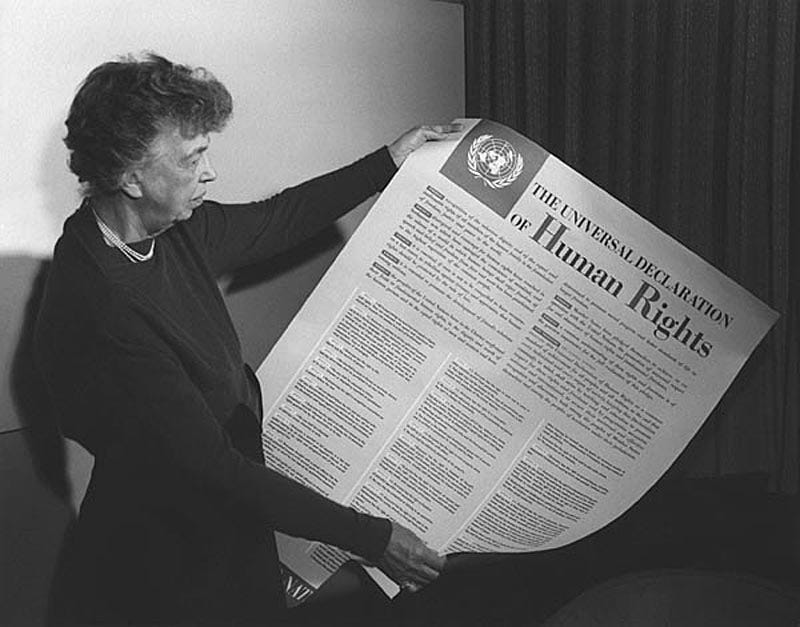
The piece opens with a recording of Eleanor Roosevelt reading from the preamble to the Declaration. After her husband’s death she devoted herself to the process of drafting the Declaration and getting it adopted by the UN General Assembly, which it was, unanimously (save abstentions from the usual suspects), on 10th December 1948.
As the prelude faded out and Christie began to read Article One, there was a palpable sense of excitement among the packed Coliseum audience. The combined effect of orchestra, soloists, spoken word and choir was mesmerising, and the punctuating passages read in myriad different languages added great pathos.
If Voices is a meditation on the possibility of a world in which the values of peace, fairness and justice replace those that underpin our current fractious world, then hearing it performed live is very much a meditative experience. I don’t think anyone was there just to hear Richter’s exquisite music, they came because they also embrace the intentions of the Declaration, and because there are so few opportunities to reflect on its values. Richter himself described the piece as ‘a musical space to reconnect with these inspiring principles’.
But if the principles in the Declaration are so inspiring, and they are, why does it feel it was adopted not just 75 years before the world was ready for it, but frankly centuries too soon?
It’s worth taking a few minutes to read the Declaration. It’s a concise, beautifully-drafted document of fewer than 2,000 words, made up of 30 articles, the shortest of which, Article 3, is just eleven words long:
Everyone has the right to life, liberty and security of person.
Certainly Article 16, on marriage and the family, is the product of a different age and needs a re-draft to make it fit for the 21st century, but the document remains an excellent overview of the high ideals to which many people, not just today, but for centuries, have aspired to. So, given it was created with the approval of nearly every nation on the planet, why has it failed to have the impact its authors intended. Why, indeed, does it appear so very far ahead of its time?
As a statement of values, or beliefs about right and wrong, it is excellent. But as a declaration of human rights, it has plainly failed to achieve its objective. This, I think, is because ‘rights’ do not exist independent of the behaviours of any individual, government or corporate body which has the power to deny them to any other individual or group. Such declarations of rights are useless in the real world because some people, some governments and many corporations have, and use, power over others which directly precludes the kind of peaceful, just and fair world the Declaration invokes.
Modernity suffers from a peculiar moral paradox: despite many, if not most, people sharing the values of the Universal Declaration, in practice, and despite the efforts of many exceptional diplomats, nations still go to war with each other. And societies that regard themselves civilized fail to put in place the mechanisms to ensure basic human rights can be enjoyed by everyone.
If people really do care about the rights of others, and if billions of us live in democracies and can choose our own leaders, why can’t we find a way to extend these rights to more people?
The answer is not complicated: despite their moral aspirations for society, good people have too little power (despite their periodic visits to a polling station), and they have insufficient understanding of the complex structures and institutions through which power is exercised by a small minority, who either don’t care about, or are ignorant of the consequences of their actions in suppressing, the rights of others.
If the Universal Declaration of Human Rights is to move from being prescriptive of how we should arrange our societies, to descriptive of how they actually are arranged, then more people need to understand the power dynamics that shape the world today. And as they come to do so, begin to reshape the institutions - political, legal and most of all economic - through which that power is currently wielded with such unjust outcomes.
The Declaration, like the UN itself, is indeed ahead of its time. It was crafted by a generation of politicians and diplomats motivated by the imperative to create conditions in which there would be no repeat of the two world wars and the Holocaust. Today, without similarly motivated initiatives, we face the possible collapse of our civilization, and with it the withdrawal of basic human rights from many more millions of people. The need for inspired moral leadership, like that provided by Eleanor Roosevelt, has never been greater.