

A Tale for our Times
English National Opera's revival of The Handmaid's Tale reminds us of the central message of Margaret Atwood's original story, one now more urgent than ever

The only good thing to the come out of the wilful destruction of English National Opera (ENO) by Arts Council England, under orders from the current abysmal and philistine UK government, is that it has obliged the company to revive some of its finest productions sooner than it otherwise might have done.
Poul Ruder’s The Handmaid’s Tale is a case in point: First performed in 2000, and premiered on these shores by ENO in 2003, the recent revival of Annielise Miskimmon’s overwhelming 2022 production was a reminder of the crucial role that ENO plays in promoting contemporary opera in Britain, and of the success of its strategy to bring opera to a younger audience. I wouldn’t be surprised if half those in the Coliseum the other Saturday evening were attending an opera for the first time.
In terms of bums on seats, the production was a another huge success for ENO and evidence of a massive cross-generational audience for opera in London, where, simply by dint of the city’s population and the number of foreign visitors it attracts, ENO is regularly able to fill its Coliseum home, the largest of all London’s West End theatres. I would be happy to be proved wrong, but I doubt ticket sales in Manchester, once ENO moves there in 2029, will match those in London. Should Labour win the election later this year, let’s hope they have the foresight to reverse this daft decision.
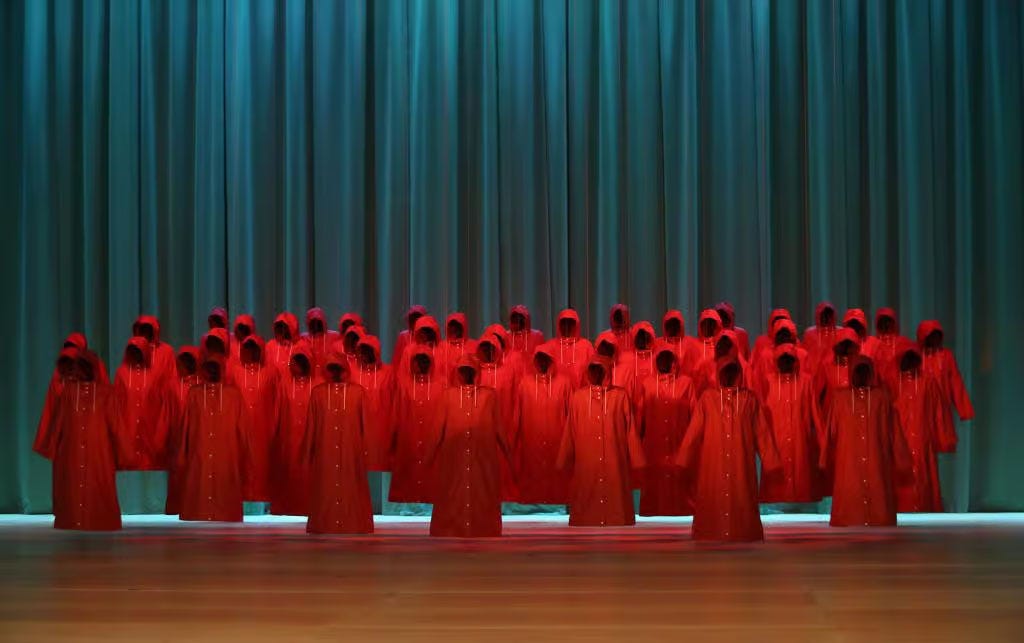
The success of The Handmaid’s Tale is all the more remarkable given the difficult subject matter of Margaret Atwood’s 1984 novel, to which the libretto cleaves closely; and the nature of Ruder’s score, which is not as accessible as some of the contemporary operas with which ENO has had similar success in recent years.
Music written to accompany the horrors of Atwood’s story is never going to make for easy listening, not if it’s going to reflect events on stage. But Ruders gets it absolutely right, especially the writing for Aunt Lydia, sung and acted superbly this time around by Rachel Nichols; a more sadistically evil character than the one portrayed in the Hulu TV series. Similarly his writing for Offred, portrayed once again by the exceptional Kate Lindsay, not just one of the world’s finest sopranos, but a very fine actress to boot.
But in reviving The Handmaid’s Tale, ENO isn’t just trying to replenish its emptying coffers. Like the TV series, the producers are also inviting audiences to reflect on the warnings implicit in Atwood’s novel.
Juliet Stevenson opens the evening: she is Professor Pixioto, a historian giving the keynote speech at the 12th International Symposium for Gilead Studies in 2195. She has unearthed ancient ‘audio cassette tapes’ onto which a young woman recorded her experience in the period following the overthrow of the United States government at a point in the near future. (The novel was published in 1985).
Paul Bentley’s libretto reminds us of the conditions that led to armed insurrection in the United States, and which are alluded to in the original: The crisis begins with an earthquake on the San Andreas fault line which prompts the evacuation of California, as nuclear power stations and other industrial facilities release all manner of pollutants into the atmosphere, ultimately causing a cataclysmic drop in fertility rates. If you haven’t read the book, seen the film, watched the TV series or heard the opera, you really should, because while Atwood wrote it in reaction to the backlash against the gains made by and for women from the 1960s on, her dystopian vision for the future is even more relevant today than forty years ago.
While she was writing the novel, people of my generation were protesting against the transformational politics of Ronald Reagan and Margaret Thatcher, which, I think correctly with hindsight, we perceived as likely to increase the gap between rich and poor and do nothing for those at the bottom of society. (Mind you, what we would give for politicians of their calibre leading the Republican and Conservative parties in the US and Britain today?)
The rise of authoritarian populist politics across the world may well be the endgame of the changes Reagan and Thatcher set in train, but how likely is the scenario like that plays out in The Handmaid’s Tale?
We’ve certainly moved a lot closer to a catastrophic triggering event in the last four decades. Fertility rates are decreasing across the rich world. This may in part be due to anthropogenic pollution, obviously of greenhouse gases (carbon dioxide and methane) but also microplastics: A recent study reported in The Guardian found microplastics in every human placenta it examined. Another referenced ‘super emitter’ escapes of methane from the massive rubbish dumps around India’s most populous city, Delhi. It’s inconceivable that sustained high levels of pollution will not have some impact on human reproductive capabilities.
But slowing birth rates may also have an economic cause: with life becoming more of a struggle for more people compared with their parent’s generation, there are bound to be fewer births. The economic implications of the replacement birth rate falling below 2.1 have been well documented and won’t help: if people have too few children, our collective ability to create wealth will be reduced, leading to yet more people deciding not to have kids.
An earthquake along the San Andreas fault line sparked the sequence of events that lead to the rise of the military-authoritarian, misogynistic, book-burning culture of Gilead in The Handmaid’s Tale. But more probable, and many times more devastating, would be an earthquake and tsunami caused by the Cascadia fault, further up the pacific coast. This fascinating 2015 New Yorker article explains what will happen when Cascadia blows. The last time it corrected was in 1700, and there’s a 30 per cent chance of another quake within the next 50 years. And guess what: the Americans are way behind the Japanese in terms of their preparations for ‘The Really Big One’.
So a triggering event could well happen, but looking at the US political situation today, it might not even be necessary. It seems increasingly possible that democracy could end at the hands of a far-right, fundamentalist government anyway. And if Donald Trump is re-elected in November, that dreadful prospect becomes more likely. Although Trump himself appears driven by ego rather than ideology, there are plenty of far-right maniacs poised to take advantage of the political chaos that would follow his re-election. If Trump doesn’t survive a full-term - and he’s clearly not a well man - he may well be replaced by someone who does have a deeply-held and genuinely scary vision for the future of American society.
In The Testaments, Margaret Atwood’s 2018 sequel to The Handmaid’s Tale, we learn that leaked information about the hypocritical excesses of the Gilead elite eventually provokes a military coup and the restoration of the United States government. But apart from the horrors detailed in each of the novels, she gives little guidance on what we should do to avoid a similar fate befalling the real world.
In my recent article Two Tribes, I argued that long-term stagnation in real wages in the US was a key factor in the political rise of Donald Trump. We urgently need to fix the economy so it’s better able to deliver on the aspirations of ordinary people, which are currently stifled by the prevailing order.
But we also need a concerted campaign to resurrect the notion that Truth Matters; to persuade people that it’s worth making the effort to sort facts from the politically-motivated fictions that are now the staple of many people’s media consumption. And that requires some honesty on the part of mainstream politicians, and an acknowledgement that the neo-liberal economic paradigm has not delivered for goods for large swathes of the population. People may be turning to populist politicians because they are unhappy with the way the world is going. But as Margaret Atwood warned us so eloquently, nearly 40 years ago, the alternative is far, far worse.