

Engaging the Disengaged
Decent people everywhere have given up on politics, and that's a disaster

As I said in in this post back in October,
‘Much of my writing here at Progress & Survival over the next year or so will focus on how we prevent what’s currently happening in the United States being repeated here in Europe.’
And so it continues. Today I want to focus on those people who have lost (or never had any) interest in politics; those who believe politics and politicians can make no difference to their lives; and those who do vote, but vote on a whim: people who are disinterested in politics but turn out to vote anyway; the electoral equivalent of those who go to the cinema not because they want to see a particular film, but because they fancy a night out and are happy to choose when they get there.
If this sounds flippant, it is not intended to, because there are a great many such people, and their actions - whether they vote or not - can have a massive impact on electoral outcomes.
I bear no ill will towards such people. Given the state of the world, and the very real failure of politicians to make any difference to people’s lives, it is perfectly understandable, and indeed quite rational, to ignore politics.
Nor should anyone be blamed for their apathy: it is entirely the fault of politicians; the mainstream media which intentionally portrays politics as a circus; and an education system that completely fails to equip young people with the tools for making electoral decisions once they become adults. Of course, schools are put in an impossible position by politicians and the media, both of which insist that education remain politically ‘neutral’ even if this means presenting young people with a partial view of reality.
Political disengagement might be less harmful when things are going well: when most people sense that their prospects are better than those of their parents’ generation, or when they feel their concerns are being listened to. If things aren’t broken, then why risk change by meddling in politics?
But the data on turnout at UK General Elections suggests the opposite happens: Between 1945 and 1997, when (I think) most people would agree that politicians were more responsive to voters’ concerns, and there was neither the polarisation in political views we see today, nor such extreme levels of inequality, average turnout at UK general elections was 76.3 per cent.
In the seven general elections since the turn of the century, average turnout was just 64 per cent. In terms of the number of people eligible to vote, that 12.3 percentage point drop represents nearly 6 million people, people who may well have voted in 1997, but couldn’t be bothered to last year. Imagine the difference those people could have made given how many seats were won by narrow margins in 2024: nearly a fifth of seats in the House of Commons, 115 in total, were won by a margin of 5 per cent or less1.
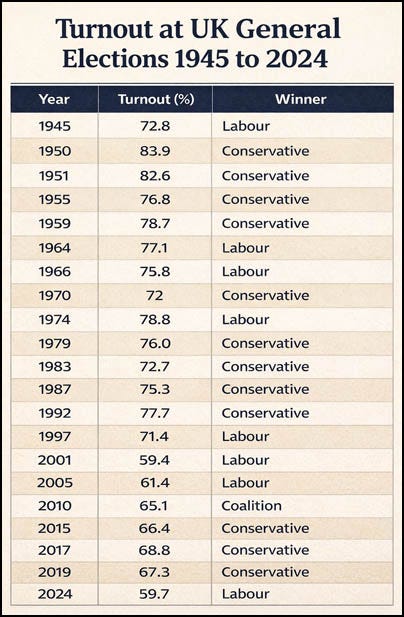
As you can see from the table above, the three lowest turnouts have all been when polling has suggested the result is a foregone conclusion, and all three were Labour victories: in 2001, 2005 and 2024.
But in less than two years since Keir Starmer led Labour to a landslide, the electoral landscape has changed more than it did in the previous eighty, as a result of the emergence of Reform UK as a serious electoral force.
I’ve written previously about the likely consequences of a Farage premiership, and they are not good. But his party’s performance in opinion polls is almost entirely down to the failure of Keir Starmer to use the immense opportunity afforded by his commons majority to take positive steps to address the electorate’s legitimate concerns, and to tell a better story about how we got here, and how his government is going to get us out of the current mess. (I also wish they would make more noise about the positive things they are already doing, because there is much good stuff that simply isn’t being reported.)
This failure has been compounded by his decision to tack to the right and echo Reform UK’s racist sentiments on immigration, a tactic that has cost labour dearly: According to a recent YouGov poll, 24 per cent of 2024 Labour voters now say they will vote Green or Lib-Dem, while 8 per cent would vote for Reform. The same poll found that no 2024 Reform voters would switch to Labour2.
Whoever leads it, the current Labour government can no longer afford to be cowed by fear of what might happen in an election that is still more than three years away. And while there is clearly a solid core of voters who will vote Reform in 2029 come what may, I doubt this amounts to anymore than 20 per cent of eligible voters; this only makes it more important that we find ways to re-engage disengaged voters, as they can clearly make a difference.
Many countries - Australia is the example most commonly cited - have legislation compelling people to vote. While this might help here in Britain, I wouldn’t be surprised if it also led to a surge in support for the likes of Count Binface and The Monster Raving Loony Party. While more people would vote, it wouldn’t necessarily increase political engagement.
A better solution would be for more politicians to succeed in cutting through with relatable stories about the causes of the current dissatisfaction with politics, and Britain’s implacably moribund economy. Mainstream politicians must also be far more vocal about the likely consequences of a Reform UK government. We know what they will do: they will do to Britain what Trump has done to the United States. And in terms of the economy, things will get far worse, more quickly, because Farage will inherit an economy in a worse state than Donald Trump did.
In just over two weeks, assuming he survives that long, Keir Starmer will face his next major electoral challenge in the Gorton and Denton by-election, in which Reform UK is fielding the vile Matt Goodwin. Despite massive media coverage of its import, and the consequences of a possible Reform victory, this by-election will further serve to highlight the dangerous level of disengagement with politics.
Average turn out at the last three parliamentary by-elections was just 36.7 per cent. Just over a third of people could be bothered to turn out to choose their MP.
In the last ten by-elections, the average turnout was only slightly better at 41 per cent. At only one of those - Tiverton and Honiton in June 2022 - did turnout top 50 per cent. I wouldn’t be at all surprised if, despite the hype, and despite the very real possibility that a Reform victory could define political debate between now and the next election, turnout in Denton and Gorton is only around 50 percent.
Of course there’s a chance that efforts to get more people to vote could lead to more people voting for Reform. But my sense is that in every part of Britain, reasonable, decent people far outnumber the Faragist haters, and they will recognise the threat to democracy posed by the far right and ultimately vote to keep them out of power.
It is ironic that while people may have rightly concluded that mainstream politicians are no longer able to make a difference to their lives; should Farage, Goodwin and their cronies form the next government, the difference a certain kind of politician can make will be felt in every household up and down the land. And it will not be a good feeling.
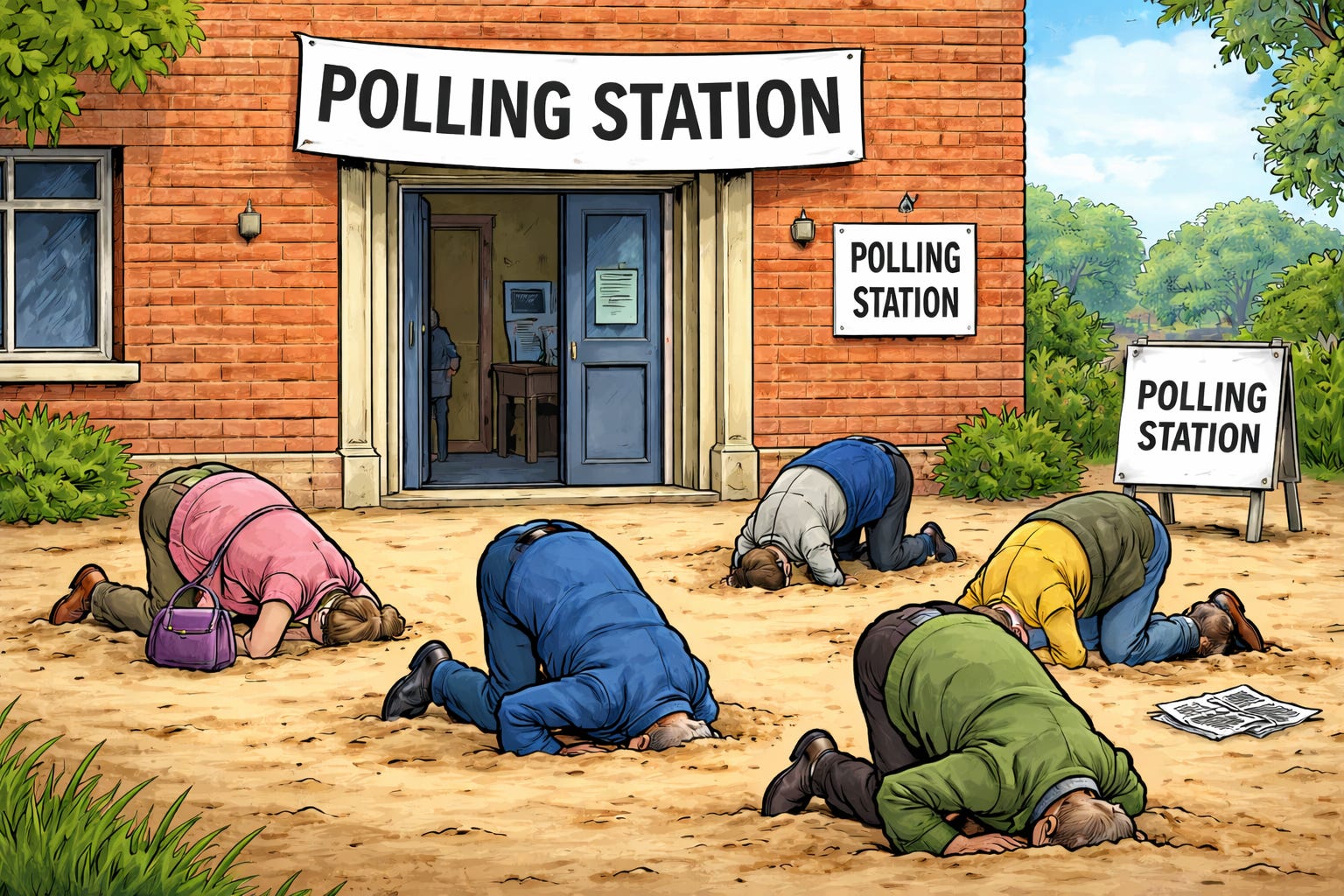
Burying your head in the sand is no longer an option if you care about the future of Britain. If you want your children to have better prospects than you did, then you have to vote, and you have to vote positively for that outcome. A vote for Farage is at best an act of despair. And democracy and despair do not make good bedfellows.
Call them what you like, but fascists, authoritarians, racists, liars, charlatans, people who care nothing for the interests of anyone but themselves, only win elections when too few decent people bother to vote.
Democracy is the only weapon we have in the struggle against tyranny. Since 1945, in many countries of the world, we have become pretty adept at using it. It would be a tragedy if we gave up on it now.
https://commonslibrary.parliament.uk/2024-general-election-marginality/
https://substack.com/home/post/p-185545510